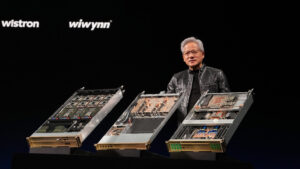
Taiwan is home to more than 500 NVIDIA ecosystem partners. More than 1 million NVIDIA MGX rack components for NVIDIA Vera Rubin infrastructure come together in Taiwan, from across 25 factory sites.
As Vera Rubin ramps into full production to power agentic AI factories worldwide, that ecosystem spans the full supply chain — from key wafer and chip partners such as TSMC, SPIL, Kinsus, KYEC and UMTC, to manufacturing and systems leaders including Foxconn, Pegatron, Quanta Cloud Technology (QCT), Wistron and Inventec.
But these partners are doing more than building AI factories. They’re applying accelerated computing, simulation, AI agents and physical AI to their own operations, creating a model for how AI can make advanced manufacturing faster, more efficient and adaptive.
Taiwan’s Manufacturing Leaders Build the Future of AI, With NVIDIA AI
Across chipmaking, server assembly and factory operations, Taiwan’s manufacturing leaders are applying NVIDIA technologies to reshape how AI infrastructure is designed, built, tested and scaled.
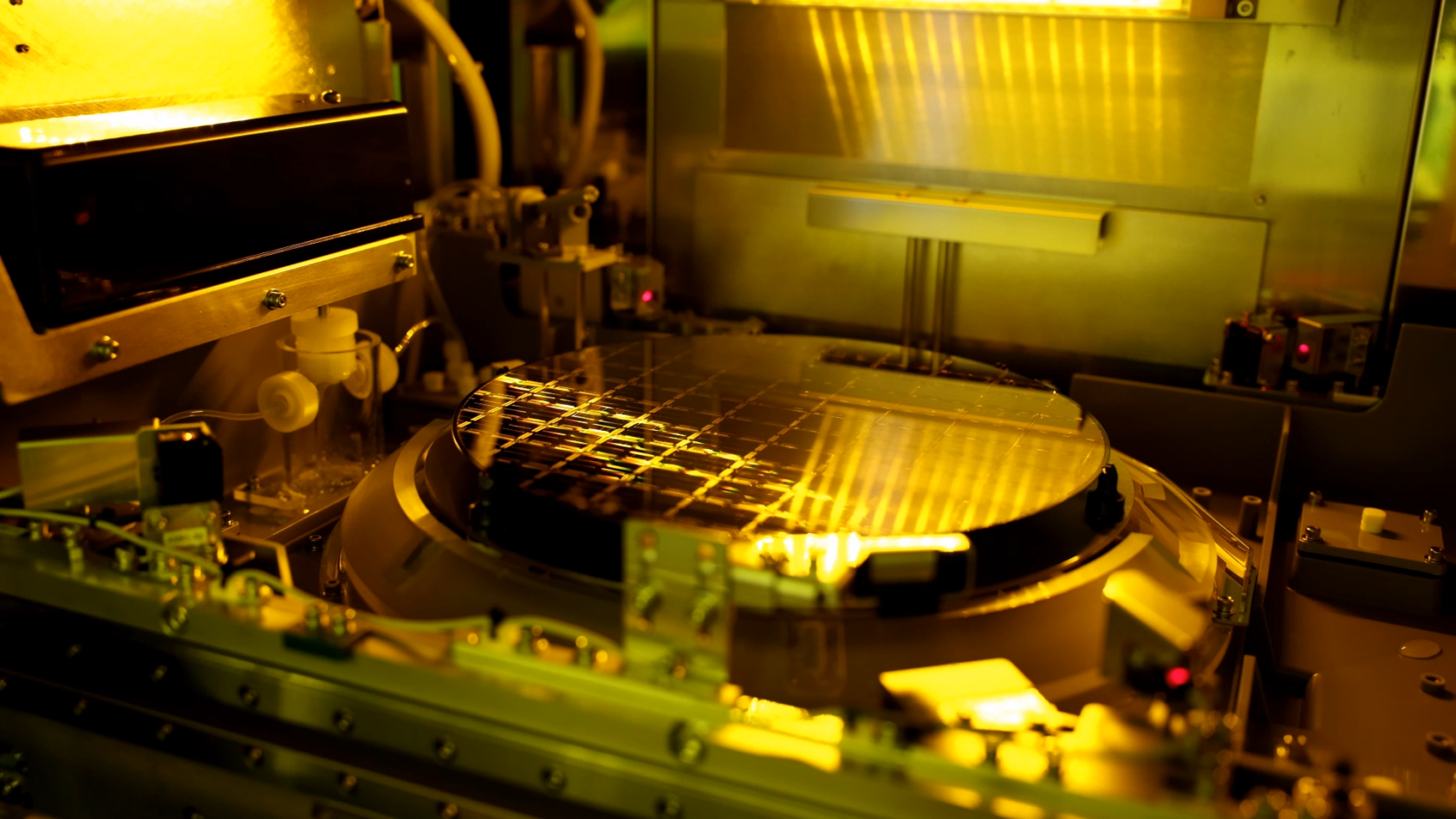
TSMC is applying NVIDIA CUDA-X libraries and AI models across computational lithography, transistor and process simulation, advanced process control, yield analysis, fab operations and inspection. NVIDIA cuLitho improves cost-effectiveness or cycle time by 20-50% over CPU-based computational lithography at the same cost of ownership, while the NVIDIA cuEST library improves semiconductor material simulation by 50x on average, cuML library, Metropolis platform and TAO Toolkit help accelerate material simulations, improve process control and strengthen rare-defect inspection.
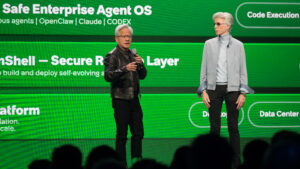
Foxconn is using the new NVIDIA Factory Operations Blueprint and NemoClaw blueprints to build MoMClaw, its manufacturing operations management agent, connecting sensor and machine signals with specialized agents that give plant managers and operators real-time answers and action plans through a natural language interface with NVIDIA OpenShell privacy controls and safety guardrails.
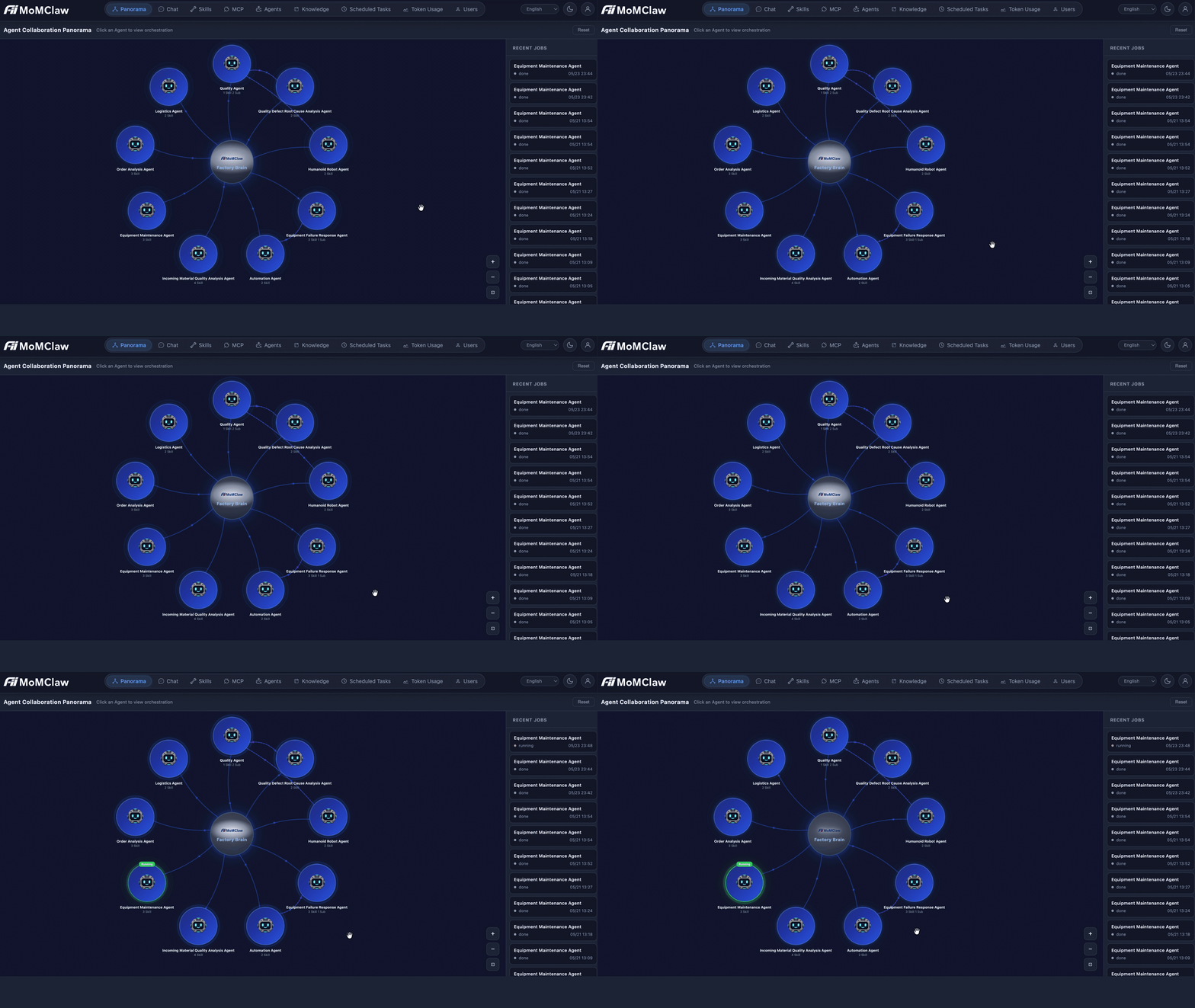
Foxconn estimates an 80% speed up in root-cause analysis time, a 15% increase in labor productivity and a 10% decrease in machine failure rates.
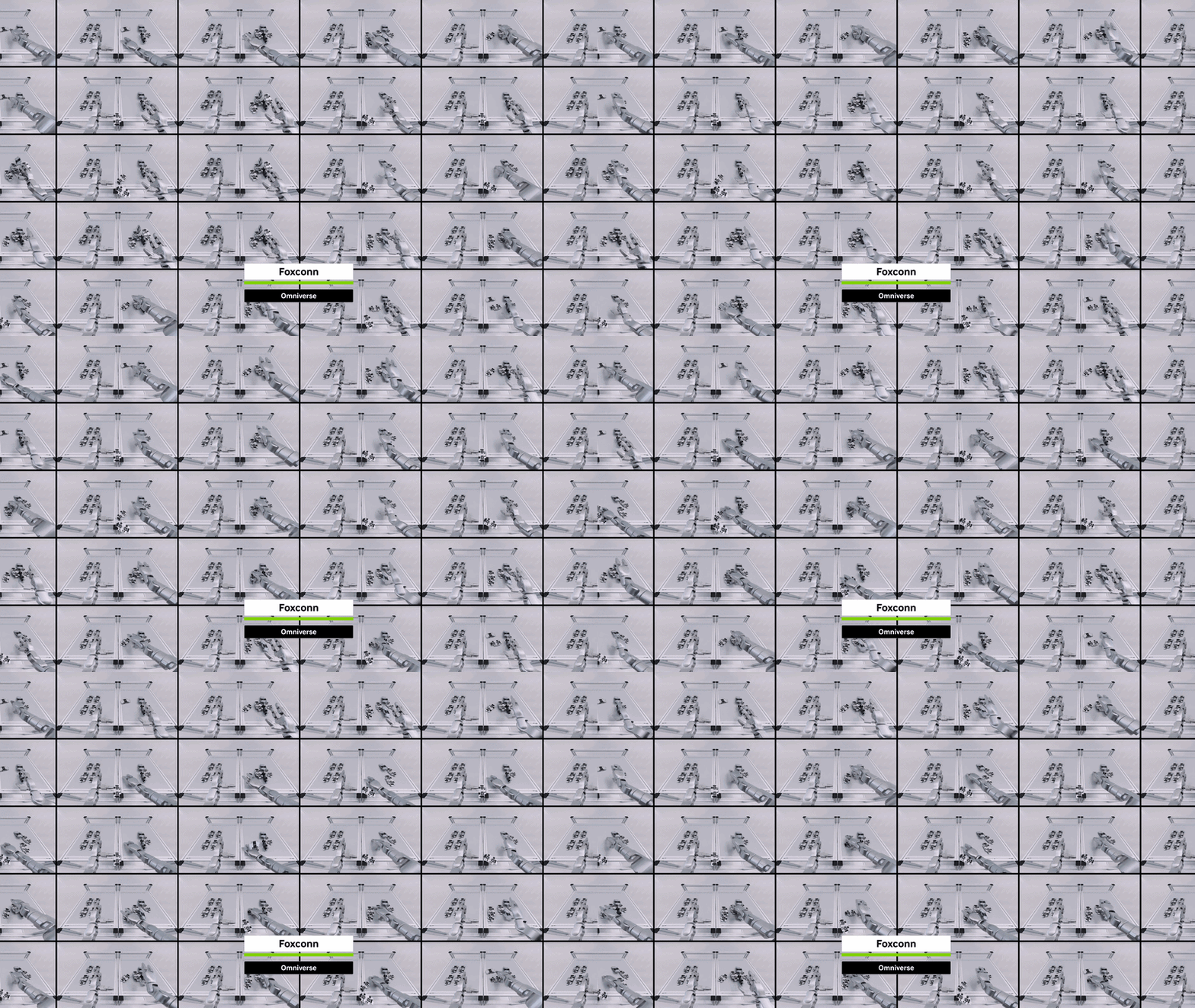
Foxconn also uses DeepHow’s SOP Verification vision AI system using NVIDIA Cosmos and the NVIDIA Metropolis Blueprint for video search and summarization (VSS) to gain greater visibility into complex manufacturing processes, resulting in improved manufacturing efficiency and boosting first pass yield by 3%. The company is also applying NVIDIA Isaac Teleop, Isaac Sim, Isaac Lab and ROS 2 to wheeled humanoid robots operating in its factories, supporting precision assembly tasks such as pick and place, dual-arm collaboration and force-controlled screw fastening.
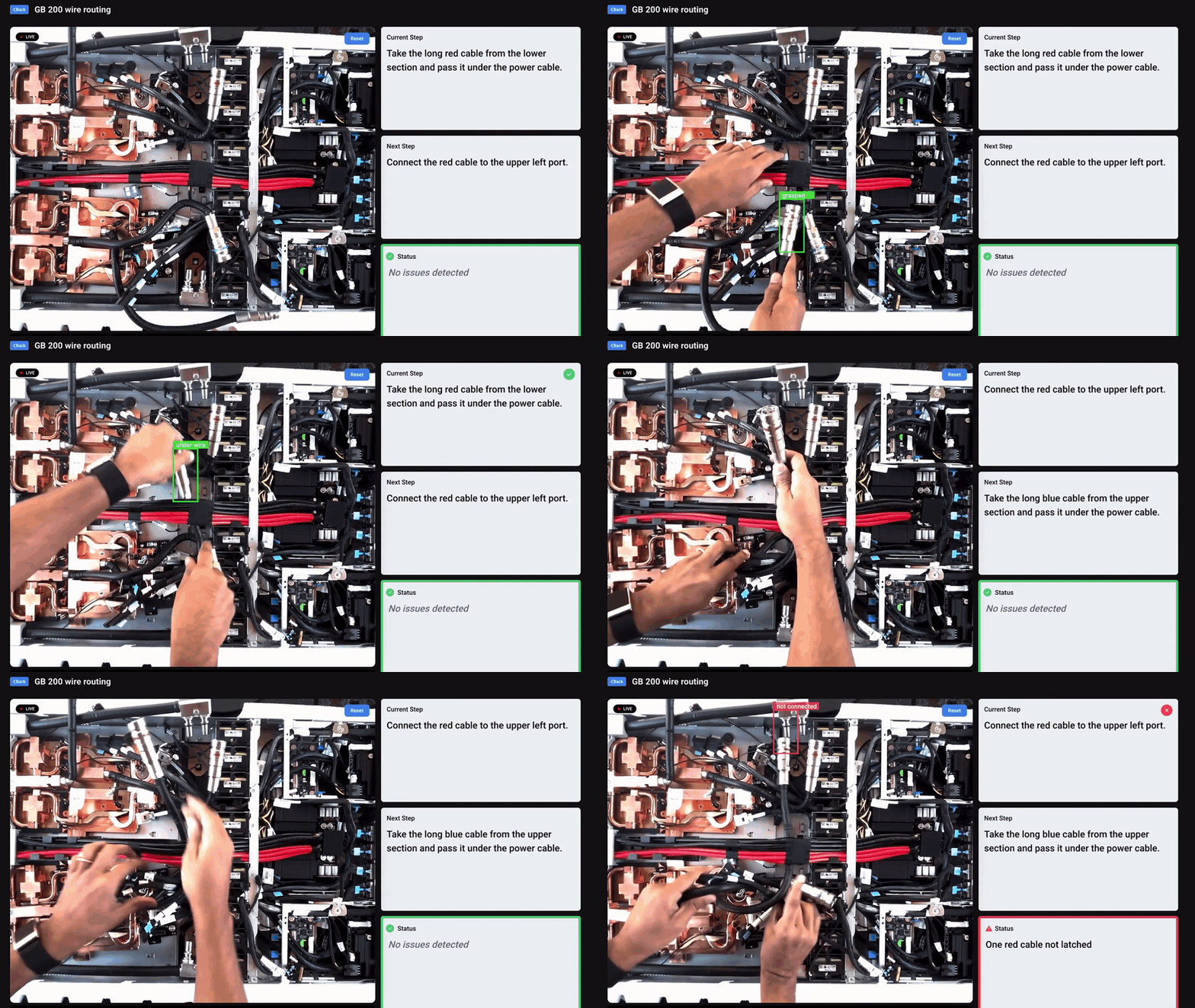
Foxconn’s $1.4 billion AI cloud supercomputing center in Taiwan — powered by 10,000 NVIDIA GPUs — is being built with the NVIDIA GB300 NVL72 hybrid cooling architecture.
Quanta Cloud Technology (QCT) is using NVIDIA Omniverse-based digital twins to accelerate factory planning, giving engineering, operations and logistics teams shared access to design data for faster layout feedback, optimized workflows and improved space utilization.
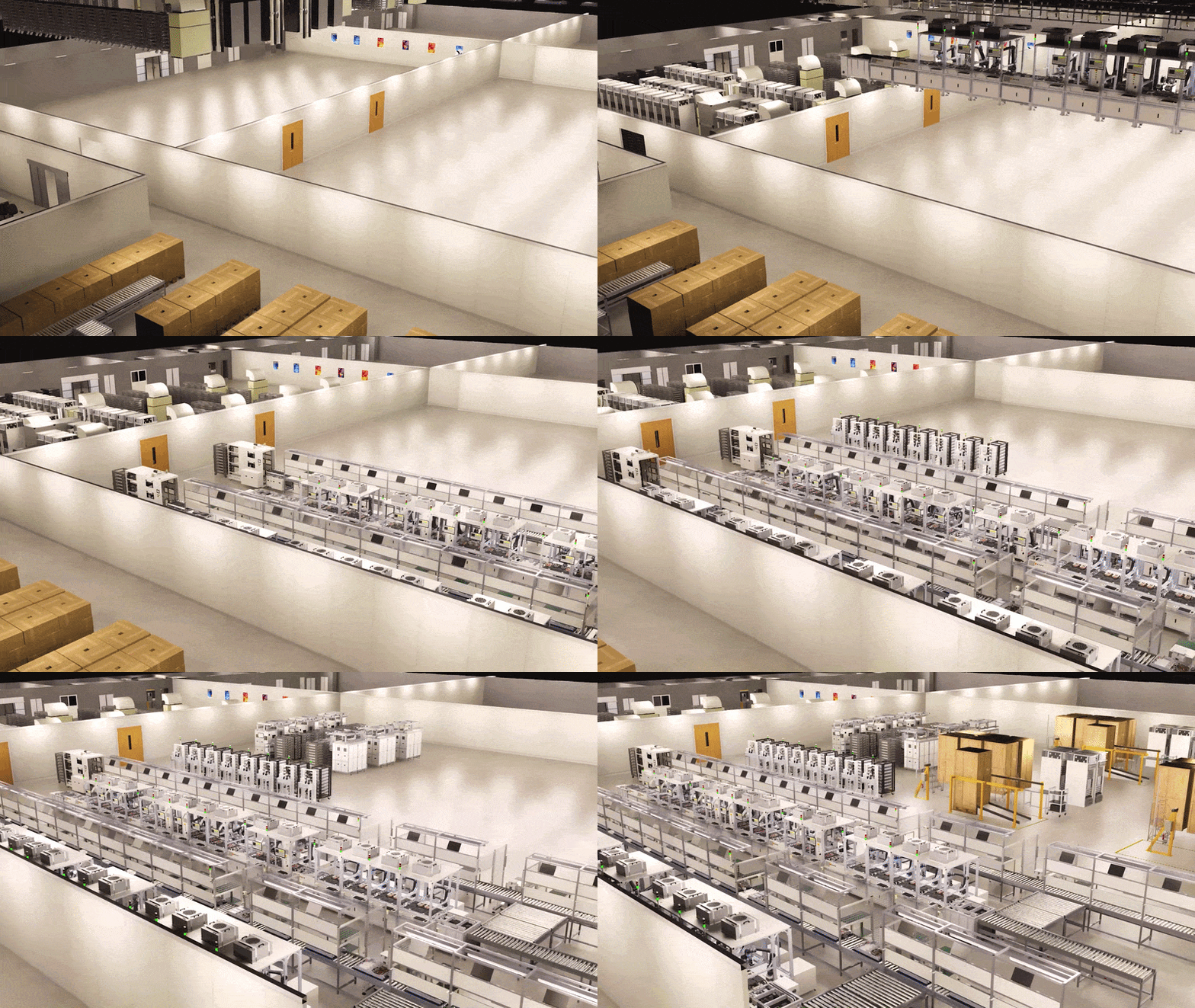
QCT is also working with its subsidiary Techman Robot on a physical AI developer kit that uses QuantaGrid systems for data generation and model training. Techman Robot is using NVIDIA Jetson Thor and the Isaac GR00T platform to support the development of its next-generation robots, including the TM Xplore I humanoid, for advanced industrial tasks such as server fan assembly.
Wistron is using the NVIDIA Omniverse DSX Blueprint, the NVIDIA PhysicsNeMo framework and Cadence Reality DC Design to simulate burn-in environments for stress-testing across global manufacturing sites and to optimize AI server manufacturing.
Running on Wistron’s NVIDIA AI infrastructure with NVIDIA RTX PRO 6000 Blackwell Server Edition GPUs, NVIDIA Omniverse and NVIDIA Metropolis libraries, these workflows speed layout analysis by as much as 70% and cut facility power demand by 20% through dynamic rack optimization.
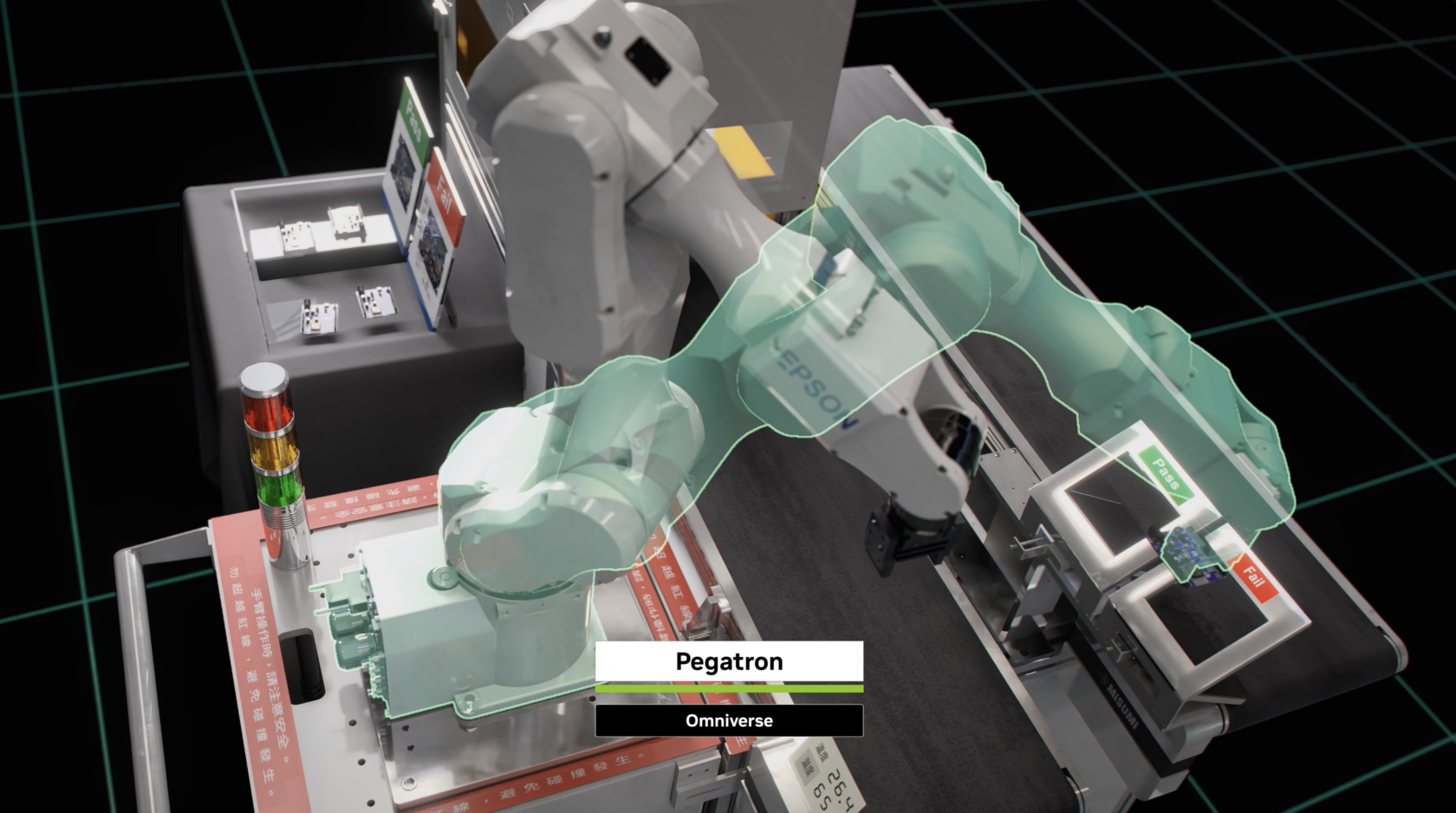
Pegatron is adopting the NVIDIA Omniverse DSX Blueprint, developing simulation-ready assets, and connecting design data, thermal simulation, digital twins and physical qualification — accelerating the design and deployment of AI factories.
Pegatron is also using NVIDIA’s Defect Image Generation physical AI agent skill with NVIDIA Cosmos world foundation models and Isaac Sim to generate synthetic defect data, reducing AI visual inspection deployment time by 67% and operational effort by 10%.
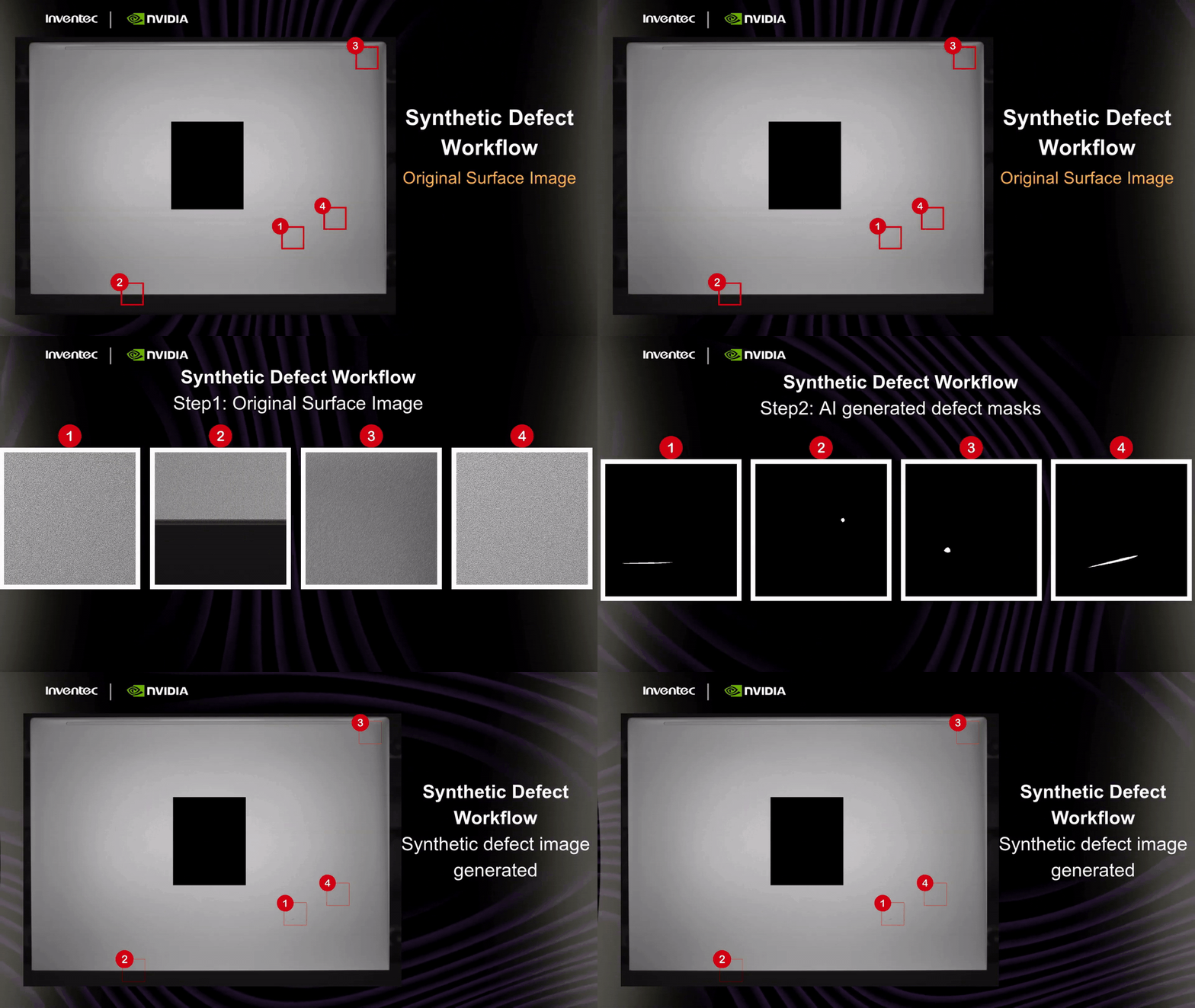
Inventec is using the Defect Image Generation agent skill in its Observation Agent to generate synthetic defect data for automated optical inspection. In notebook cosmetic inspection, internal validation produced more than 10,000 synthetic defect images and showed the potential to reduce real-world data collection and manual labeling by about 30%, shorten AI deployment time by about 25% and improve anomaly detection by about 10%.
As NVIDIA Vera Rubin ramps into full production, Taiwan’s manufacturing leaders are showing how AI infrastructure becomes part of its own manufacturing engine — using accelerated computing, simulation, agents and physical AI to build the next generation of AI systems.
Watch the GTC Taipei keynote from NVIDIA founder and CEO Jensen Huang and explore physical AI sessions.